
Real - Sports
Real VaultSports
4.3720.00 Reviews
- Version
- 6.0
- Installs
- 500.00K
- Age Rating
- Everyone
Screenshots
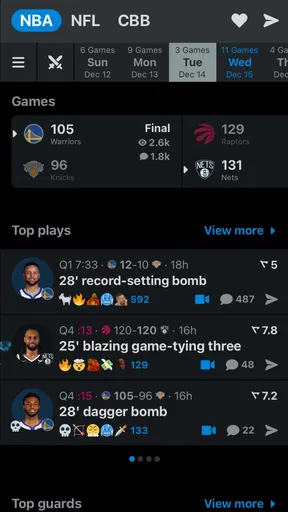
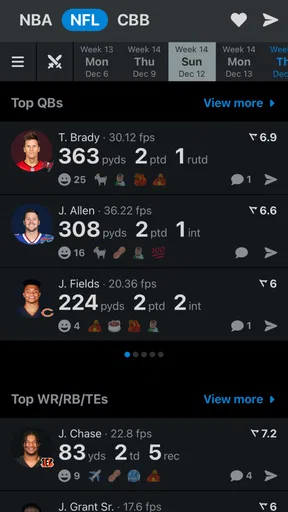
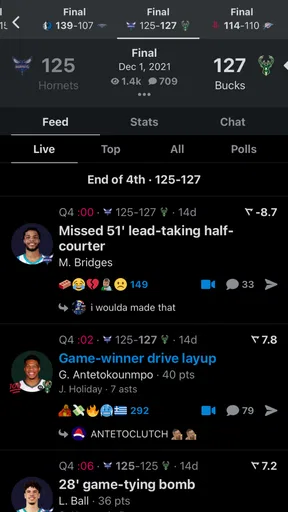
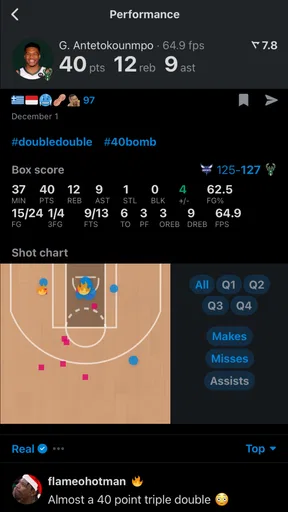
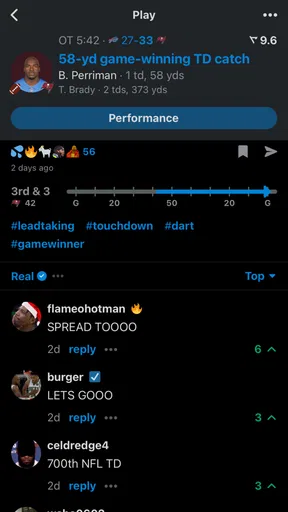
Our Review of Real - Sports
 Analysis by Appyee
I opened Real - Sports expecting a straightforward place to talk about sports and make predictions, but its appeal is slightly broader: it turns following a match into a small social routine. Instead of only checking a score or reading a news headline, I can discuss an event, record my expectation, and see how my view compares with other people’s opinions. That combination makes it feel more interactive than a standard sports-results app.
It is a free sports app from Real Vault, available to an Everyone audience. The current release is version 6.0, and it supports devices running Android 7.0 or later. Its store presence is already substantial, with more than half a million installs and a 4.9 average from roughly four thousand ratings. Those figures suggest that the concept has found a receptive audience, although popularity alone does not make every part of the experience equally useful.
From a sports question to a shared prediction
The best way to understand the app is to follow a normal use case. Imagine that I am waiting for a major game later in the day. I already have a team in mind, but I want more than my own guess. I open Real - Sports to find a discussion, read what other users are saying, and then decide whether I want to add my prediction. The starting condition is simple: I have an opinion, but no satisfying place to test it socially.
That distinction matters. A conventional sports app is usually built around information delivery. It may give me scores, fixtures, standings, or news, but it does not necessarily invite me to explain why I expect one outcome. Real - Sports is more useful when I want participation rather than passive checking. The app’s central idea is not just “what happened?” but also “what do people think will happen?”
When I first use an app like this, I would approach it with a specific question rather than browsing without a goal. For example, I might want to compare opinions before a match, follow a particular conversation, or see whether my prediction agrees with the wider community. That mindset keeps the experience focused. Without a clear event or topic in mind, a discussion-led sports app can feel less immediately organized than a dedicated score service.
Finding a useful conversation
The first practical step is locating the sports discussion that matches my interest. Once I find it, I read before contributing. This is more valuable than posting immediately because the existing conversation gives me context: whether people are making serious predictions, sharing quick reactions, or simply supporting their favorite side. The difference affects how much weight I give to what I read.
I also treat the conversation as a temperature check, not as expert analysis. A strong majority opinion can be interesting, but it should not replace my own judgment. Sports communities naturally contain enthusiasm, loyalty, and emotional reactions. That is part of the fun, yet it can also make a popular prediction feel more convincing than the reasoning behind it.
A useful personal habit is to separate three things while reading: factual observations, personal preference, and confidence. Someone may mention a team’s recent form, openly support that team, or simply make a confident guess. Those are different kinds of contributions. Keeping them separate makes the prediction stage more thoughtful and prevents the social side from becoming a popularity contest in my head.
Making the prediction count
After reading, I move from observation to participation. I choose my prediction and use the discussion to compare my thinking with other users. This handoff—from reading to committing—is where the app becomes more engaging than a normal comment feed. I am no longer only consuming opinions; I am putting my own view into the same shared space.
I would not use the prediction feature as a substitute for careful research when the decision has serious consequences. It works best as a lightweight way to express sports knowledge, intuition, or loyalty. The value comes from the comparison and the conversation, not from treating every prediction as a dependable forecast.
One of the more useful workflows is to make my prediction before revisiting the discussion too many times. If I keep reading until I find an opinion I like, I may end up copying the mood of the group rather than forming my own view. I prefer to note my initial expectation, read the strongest arguments, and then decide whether to keep it or change it. That gives the social element a constructive role without letting it completely drive the outcome.
The handoff from prediction to competition
The competitive layer gives the prediction a reason to matter after I have submitted it. Instead of the interaction ending with a comment, I can treat the result as part of an ongoing comparison with other participants. This is a small but important design choice: the app connects discussion with personal performance, so participation has a memory beyond the individual event.
That handoff is also where expectations need to stay realistic. “Compete” does not automatically mean the experience will satisfy someone looking for a full fantasy league, a detailed betting interface, or a deep statistical simulator. I see it more as social competition built around sports opinions. If I want complex roster management or advanced analytics, a specialized sports platform will probably be a better fit.
For casual groups, this can still be enough. Friends can use a shared event as a reason to check in, state their views, and compare outcomes afterward. The app is particularly appealing when the social ritual matters as much as the prediction itself. It gives a sports conversation a beginning, a decision point, and a result to revisit.
What the result feels like
The outcome is not only whether my prediction was right. The more interesting result is the feedback loop: I saw a discussion, formed an opinion, entered it, and later had a reason to look back. That sequence makes a match feel more personal because I have a small record of what I expected before the action unfolded.
In an everyday scenario, I might check the app during a lunch break, read the conversation about an evening fixture, and submit my view before returning to work. Later, I can come back to see how the event turned out and compare my expectation with the community’s. This is a realistic use case because it does not require constant attention. The app fits around the sports event rather than demanding that I watch every moment through it.
The same workflow can work for someone who watches sports with friends but lives in a different place. A prediction gives everyone an easy opening message, while the discussion provides something to return to after the match. It is less formal than organizing a league and more engaging than sending a single group-chat opinion that disappears among unrelated messages.
For new users, I recommend starting with one sport or one event instead of trying to follow everything. A narrow routine makes it easier to judge whether the conversations are useful and whether the competitive aspect adds enjoyment. If I follow too many topics immediately, the social feed can become noise, particularly when my main interest is only a small set of teams or competitions.
Where the flow becomes less comfortable
The same social design that makes Real - Sports interesting can also create friction. A discussion-based experience depends on the quality and activity of its community. If a topic has little participation, the app may feel less rewarding than a conventional sports app that can still provide scores or structured information on its own. The strength of the experience is therefore closely tied to whether other people are discussing the events I care about.
There is also a difference between wanting a prediction and wanting certainty. The app can help me compare opinions, but it cannot remove the unpredictability of sport. A confident community consensus may still be wrong, and a quiet discussion may contain the most sensible view. I would use the app to make following sport more interactive, not to outsource judgment.
Another limitation is focus. Someone who wants a clean, fast glance at a score may find a social layer unnecessary. A dedicated results app is usually better for checking a fixture in a few seconds. Likewise, a person who wants long-form reporting, player statistics, or detailed tactical breakdowns may prefer a specialist news or analysis service. Real - Sports earns its place when discussion and prediction are the main reasons for opening it.
I also think the competitive angle can change the mood of a conversation. For some users, it adds motivation and makes predictions memorable. For others, it may make a relaxed sports discussion feel like a ranking exercise. That is not a flaw for everyone, but it is an important trade-off. I enjoy competition when it stays playful; I would skip this app if I wanted sports talk with no element of comparison.
Who will get the most from it
I would recommend the app to sports fans who enjoy forming opinions before an event and hearing how other people see it. It is a good match for someone who likes the social side of sport, wants a simple way to participate, and does not need a full statistics dashboard. It can also suit friends looking for a recurring prediction habit without setting up a complicated private competition.
It is less suitable for users whose first priority is live data accuracy, detailed historical research, or a highly structured fantasy experience. Those needs call for different tools. I would also hesitate to recommend it to someone who dislikes public discussion or finds sports predictions stressful. The app’s point is participation, so its most valuable parts may feel unnecessary if I only want information delivered quickly.
Because it is free and rated for Everyone, the entry barrier is low. That makes it easy to try without treating the first session as a major commitment. Still, “free” does not mean it will fit every sports routine. The real question is whether I want to discuss and predict, rather than simply follow results. That is the decision that separates a useful installation from an app that sits untouched after the first opening.
My practical way of using it
My preferred routine is deliberately simple. I choose an event I genuinely care about, read several opinions, identify which comments contain reasoning rather than only enthusiasm, and make my own prediction before the conversation influences me too much. After the event, I return to compare the result and notice whether my reasoning was better or worse than my confidence suggested.
I would also avoid treating every discussion as equally valuable. A lively thread can be entertaining without being insightful, while a smaller exchange may offer clearer thinking. Looking for explanations, acknowledging uncertainty, and separating team loyalty from evidence makes the experience more rewarding. These habits are not required by the app, but they help me get more from its central workflow.
For a group of friends, I would choose a regular check-in point: everyone submits a view before the event, then returns afterward to discuss what happened. That creates a natural handoff between prediction and reflection. It also prevents the app from becoming something I open randomly without a reason. The strongest use is event-based and social, not constant background browsing.
Version, reach, and overall fit
Real Vault has continued the app through version 6.0, and the product has reached over 500K installs. Its 4.9 average across about 4.3K ratings shows that many users respond positively to the concept. I read that reception as encouraging, while still keeping the app’s purpose in perspective: a high rating does not turn it into a replacement for every other sports tool.
The app’s age rating of Everyone also makes its basic concept approachable for a broad audience. That is useful for casual family or friend conversations around sports, although the quality of any particular discussion still depends on the people taking part. The developer is Real Vault, and the product’s identity is clear enough that I do not confuse it with a score-only utility.
What I like most is the complete loop from curiosity to outcome. I begin with a sports question, move through community discussion, commit to a prediction, and return to see what the result means. That structure gives ordinary fixtures a little more involvement. It is not trying to replace watching a match; it gives me another way to engage with it before and after the action.
My final recommendation
I would recommend Real - Sports to anyone who enjoys sports conversation as much as sports information. Its strongest use is a focused routine around an event: read, think, predict, compare, and return afterward. The app is free, easy to approach, and more participatory than a typical score checker.
I would skip it if I need a comprehensive sports database, instant results with no social layer, or advanced fantasy and statistical tools. Those alternatives are more appropriate for specialized needs. For me, the app succeeds because it gives a prediction somewhere to go after I make it. Its real strength is turning a private sports opinion into a shared before-and-after experience.
That makes it worth trying for casual fans, active discussion groups, and anyone who likes a little friendly competition around a match. Just keep expectations aligned with what it does best: it is a social sports companion built around discussion and prediction, not an all-purpose replacement for every app on a fan’s phone.
Privacy and Permissions
See what permissions an app requests and how it handles your data.
- Location
- precise location (GPS and network-based)
- Photos/Media/Files
- read the contents of your USB storage, modify or delete the contents of your USB storage
- Storage
- read the contents of your USB storage, modify or delete the contents of your USB storage
- Wi-Fi connection information
- view Wi-Fi connections
- Other
- view network connections, full network access, control vibration, prevent device from sleeping
Verdict
Strengths of Real - Sports
- Covers multiple sports in one app for varied interests.
- Live updates help users follow games as they happen.
- Simple navigation makes scores easy to find quickly.
- Useful for checking results while away from the TV.
- Provides a convenient overview of ongoing competitions.
Limitations of Real - Sports
- Some features may require a stable internet connection.
- Notifications can become excessive if not customized.
- Coverage may vary depending on the sport or competition.
- Live data can occasionally be delayed during busy matches.
- The interface may feel crowded for users following many sports.
Similar Picks in This Category
View All
BeSoccer: Soccer Live Score
BeSoccer apps4.3

Cricbuzz - Live Cricket Scores
Cricbuzz.com3.7

NFL
NFL Enterprises LLC2.4

Da Fit
MO YOUNG LIMITED3.6

ESPN
Disney4.5

LiveScore: Live Sports Scores
LiveScore Limited4.5
Frequently Asked Questions
What is Real - Sports, and what can I do with it?
Real - Sports is a sports-focused application designed to help users follow sporting content in one place. Depending on the available features and supported competitions, you may be able to check scores, schedules, news, match details, team information, or other updates. The experience is intended for sports fans who want convenient access to relevant information without constantly switching between different websites or apps.
Is Real - Sports free to download and use?
Real - Sports may be available to download at no initial cost, but users should review the store listing carefully because some features can depend on advertising, optional purchases, subscriptions, or regional availability. Before installing, check the current pricing details, in-app purchase section, and required permissions. Availability of particular sports, leagues, or premium content may also vary depending on your country and device.
Which sports, teams, or competitions are supported by Real - Sports?
The supported sports and competitions can vary according to the version of Real - Sports, your location, and the content supplied by the app. Before downloading, review the application description and screenshots to confirm that it covers the leagues, teams, or events you follow. If a specific competition is important to you, it is also worth checking whether live scores, schedules, statistics, and news are available for that competition.
Does Real - Sports provide live streaming of matches or only sports information?
Users should not assume that Real - Sports includes live video streaming simply because it offers sports-related content. Many sports applications focus on scores, fixtures, results, alerts, statistics, and news, while broadcasting rights are handled separately by official networks or streaming services. Check the app’s current feature list and terms before installing, particularly if your main goal is to watch live matches rather than follow updates.
What permissions and internet connection does Real - Sports require?
Real - Sports generally needs an internet connection to refresh scores, load news, display schedules, or deliver notifications. Depending on its design, it may request permission to send alerts and use basic device or network information to improve functionality. Review permissions during installation and disable notifications you do not need. Using mobile data for frequent updates or media content may also affect your data allowance and battery life.
